
Colloidal Gold Lateral Flow Immunoassay
What it is
Lateral flow immunoassay (LFIA) is the technology behind rapid diagnostic tests — a paper-based strip that detects a target analyte via labeled antibodies and capillary flow, producing a visible line within minutes.
How it works
A sample is applied to the sample pad and migrates by capillary action through the conjugate pad (where colloidal-gold–labeled antibodies bind the analyte), along the nitrocellulose membrane (where the test and control lines are immobilized), and into the absorbent pad. A visible test line forms when the labeled complex is captured.
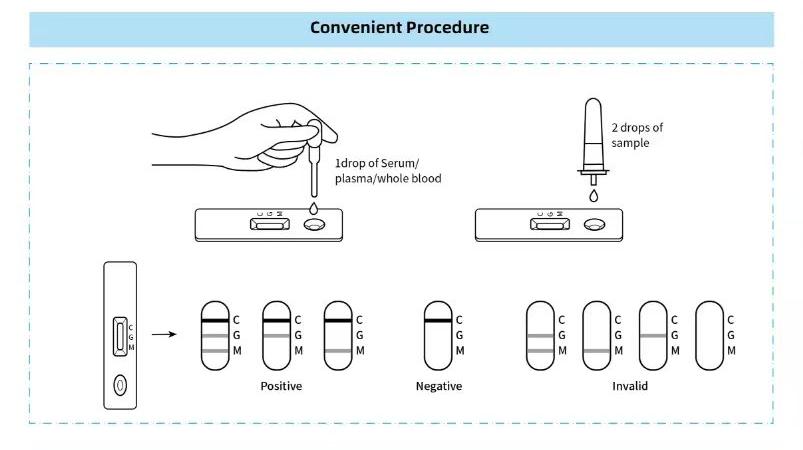
Why it matters
It is instrument-free, room-temperature-stable and read by eye — the basis for point-of-care screening across infectious disease, cardiac markers and drug testing. Understanding the components is how buyers evaluate batch consistency and cut-off reliability.
Key components
- Sample pad — receives and pre-treats the sample
- Conjugate pad — holds gold-labeled antibodies
- Nitrocellulose membrane — test and control lines
- Absorbent pad — wicks excess sample
- Backing card — structural support
Applications
- Infectious-disease screening (dengue, malaria, HIV, COVID, influenza)
- Pregnancy and fertility testing (hCG, LH)
- Drug-of-abuse screening
- Cardiac markers (troponin, CK-MB, D-dimer)
- Veterinary diagnostics
- Food-safety and environmental testing
What affects performance
- Antibody affinity and specificity
- Conjugate quality and label uniformity
- Membrane pore size and coating
- Sample matrix and viscosity
- Flow rate and reagent release
- Storage and humidity stability
Limitations
- Qualitative visual readout — faint lines are subjective
- Sensitivity may be lower than laboratory methods such as PCR
- Matrix effects and nonspecific binding raise background
- Limited quantitative capability in visual formats
Frequently Asked Questions
What is colloidal gold lateral flow? An immunochromatographic assay using gold nanoparticles as the visible label on a nitrocellulose strip.
Is lateral flow the same as immunochromatography? Lateral flow is the physical format; immunochromatography is the antibody-based recognition mechanism. Most lateral-flow rapid tests are immunochromatographic.
How long does a lateral-flow test take? Typically 10–15 minutes to a visible result, depending on the assay.
Related knowledge
- What is immunochromatography?
- Colloidal gold conjugation
- Nitrocellulose membrane
- What is colloidal gold?
- Rapid test vs ELISA
References
- Posthuma-Trumpie GA, Korf J, van Amerongen A. Lateral flow (immuno)assay: its strengths, weaknesses, opportunities and threats. Anal Bioanal Chem. 2009;393(2):569-582.
- Koczula KM, Gallotta A. Lateral flow assays. Essays Biochem. 2016;60(1):111-120.
- Bahadır EB, Sezgintürk MK. Lateral flow assays: principles, designs and labels. TrAC Trends Anal Chem. 2016;82:286-306.
- 侧向层析标记物研究进展 (Research advance of lateral flow assay labels). Journal of Biomedical Engineering. PMC9935128.
See this technology in our products → Browse catalog
Written by the Progene Bio Technical Team · Last reviewed: 2026-09-12